














































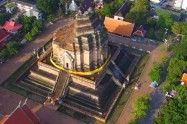




Chiang Mai Moat marks the boundary of the Old City, tracing a roughly square circuit around its temples, neighbourhood streets and historic gates. The water, surviving brickwork and restored corners make the city’s original layout easy to recognise, even as busy roads run alongside it.
A walk here is best understood as exploring a historic city edge. You can follow a short stretch between gates, pause for photographs or use the moat to connect an Old City temple visit with a nearby market. It is an everyday part of Chiang Mai, with traffic and crossings as well as attractive waterfront sections.
The Moat, Walls and City Gates
The moat belongs to the defensive plan of the city founded by King Mangrai in 1296. Water and fortifications helped define and protect the Lanna capital, while the gates controlled movement into and out of it. Restoration over later centuries means the brickwork visible today includes repaired and reconstructed sections.
Five historic gates provide useful landmarks: Tha Phae on the east, Chang Phueak on the north, Suan Dok on the west, and Chiang Mai and Suan Prung on the south. The corners also retain sections of fortification. Looking at the water and walls together gives a clearer sense of the former city boundary than photographing an isolated gate.
Choosing a Stretch to Walk
Tha Phae Gate is a convenient starting point, with a broad public square and an obvious entrance into the eastern Old City. From there, you can follow the eastern moat towards the northeastern corner or head south towards Chiang Mai Gate. Both choices let you combine water views with a manageable section of the city boundary. Traffic runs beside the moat, so use the available pavement and crossings rather than expecting a continuous quiet promenade.
A complete circuit is roughly six kilometres, depending on the paths and crossings used. Allow around two hours for an unhurried walk with stops, or longer if you enter temples or markets along the way. For most visitors, a shorter stretch is enough to understand the moat without spending the hottest part of the day beside traffic.
Gates, Markets and Temple Detours
The eastern gate connects naturally with Ratchadamnoen Road and the central Old City. Chiang Mai Gate offers a different atmosphere around the southern market streets, while the northern moat gives access to the Chang Phueak area. Use these landmarks to choose where to stop for refreshments rather than planning a rigid full circuit.
Wat Chiang Man is inside the northeastern Old City, and Wat Phra Singh is nearer the western side. A moat walk can therefore be one part of a temple outing, with the inward detour providing quieter streets and architectural detail. Carry suitable clothing if you intend to enter temple halls.
When to Visit and What to Expect
Early morning and late afternoon are generally more comfortable for walking and can give softer light on the water and brickwork. Shade is uneven, so bring drinking water and sun protection even for a short route. Stop somewhere comfortable if heat or traffic makes the full circuit less appealing.
Public moat-side streets can be visited at any time and there is no general admission charge. Nearby temples, museums and markets have their own opening arrangements and costs. At night, choose well-lit sections and crossings, and avoid getting too close to the water’s edge for photographs.
The moat is not a swimming area. Remain on the public paths and respect barriers, maintenance work and planted areas. Take extra care during busy festivals, when crowds and temporary traffic arrangements can change the usual walking route.
Getting to the Chiang Mai Moat
Visitors staying in the Old City can usually walk to the nearest side of the moat. From elsewhere, take a taxi, tuk-tuk or red songthaew to a named gate such as Tha Phae or Chang Phueak. Confirm the drop-off and fare before boarding, especially when the driver is arranging a private trip.
Driving around the moat involves one-way sections, busy junctions and limited convenient stopping space. Arrange a safe drop-off or use designated parking nearby rather than stopping on a bridge or roadside to take pictures. Use pedestrian crossings and do not assume the next narrow road opening is a safe place to cross both carriageways.
Chiang Mai Moat FAQs
How far is a complete moat walk?
Allow roughly six kilometres for a full circuit, depending on the exact paths and crossings. Around two hours suits an unhurried walk with brief stops; temple and market detours take longer.
Where is a good place to start?
Tha Phae Gate is an easy landmark on the eastern side, but the nearest gate to your accommodation may be more convenient. A short stretch between gates can be more comfortable than a full circuit.
Is the moat free to visit?
There is no general admission charge for walking the public moat-side streets. Nearby temples, museums and other attractions have separate arrangements.
Is it a quiet walking trail?
Traffic runs alongside the moat and pavement conditions vary. Expect an urban walk with crossings and roadside sections, together with pleasant water views and historic brickwork.
Can you swim in the moat?
The moat is not a swimming area. Stay on public paths, keep clear of the water edge and respect barriers or maintenance closures.
Is the moat the same as Mae Kha Canal?
They are separate waterways. The moat surrounds the Old City, while Mae Kha Canal lies outside it; use a specific gate or attraction name when arranging transport.









Do You Have a Question to Ask?